Why Most AI Is Useless & How To Make Millions With It
Want more practical business ideas for the US market?
👉 Follow us on Facebook for daily ideas and tips.
👉 Save ideas on Pinterest — or get them by email.
Turn idea into action
Calculate a business plan for this idea
Log in to generate a plan from this idea. We will reuse the article's niche and context; you only add your market location.
Log in to calculateThe State of Corporate America and AI Adoption
I'm here to report back: the state of corporate America is worse than you're assuming. It's worse than the echo chamber that Twitter paints it to be. They know nothing. You get in there, and really quickly you're going to see, 'Holy crap, they don't even know how to Google something, let alone use AI.'
The Flaws of "AI Bros" and the Exponential Growth of AI Capabilities
To most people who are sitting there, who want to be entrepreneurs, who want to figure out how to do something with AI, I'm going to say something that I think is going to shock you and your audience: go get a job. Because 99% of the things that people are messing around with don't have a use case and won't have a use case. This is in response to the common sentiment from "AI bros" on platforms like Twitter who claim, "Dude, I have 10 agents running while I sleep. No one is prepared for AGI in two years, man." They boast about being 10x more productive and maxing out token budgets, but often, when pressed, they can't articulate what they're actually building.
The reality is that this technology is changing so quickly. People are learning it so quickly. By the time you actually start seeing results, it's game over, bro. It's so soon in the cycle to be pulling out the "What are you even building?" card. We don't know what it's going to look like yet. In December, Claude Opus 4.5 could do about five hours of human coding tasks in one output. By February, it could do 15 hours. It didn't just double; it tripled in a month and a half. This exponential growth is mind-blowing.
The Analogy of Electricity and the Opportunity for AI
My analogy is electricity. When Thomas Edison first introduced electricity, people asked, "What are you going to do with electricity? Oh, you can light your house? Are you going to read books after hours?" People just didn't get it until all of a sudden, they got used to the new technology, and creative people were like, "Huh, I think I could use this for..." and pretty soon we had modern technology. We are in the very early stages of AI adoption, similar to the early days of electricity.
Another analogy: I was with some kids from church who bought a printer that can print anything on anything – tumblers, t-shirts, 30-foot banners, even custom spikes for track and field shoes. They wanted business ideas. My advice was, "Dude, you need to put this in your backpack, take it to school, plug it in, and print stuff on demand. Use this as your vehicle for rapid testing and prototyping." Don't get married to anything just yet. Just learn: Where's the demand? How much will people pay? What colors do they like? Do they want tumblers? Do they want their phone cases engraved? Stickers? Whatever. Use AI, LLMs, and agents as your rapid testing vehicles. Use them to have fun and to learn, but don't get married to anything just yet. Just be ready to pounce, and when something comes up, you're going to have all the skills necessary to execute on that thing.
Unlocking Value: The 5-Layer AI Solution
My experience reporting back from corporate America is that the state is worse than you're assuming. They know nothing. I went to an offsite with an executive leadership team and a 15-minute conversation ballooned into five hours because they were just asking me questions: "How do you do that? You can do that right now?" By the end, the CEO told me, "This is the first time I actually realized it's happening." I have an insane amount of urgency because I finally get it. I thought it was talk; I finally get it. The stuff I'm showing them is not mind-blowing to people listening right now, but to people who have real jobs, who actually have to do something on a daily basis (like accounting or caregiving), they don't have time to play around with this stuff. They don't know what it actually looks like.
This is the 5-Layer Solution. Most people start at Layer 5 (Agents), which is why their AI is useless. AI without structured data underneath it is just an expensive autocomplete. The layers are: Layer 1: Data Foundation (capture everything: emails, texts, meetings, raw material); Layer 2: Structure (organize into people profiles, project dossiers, meeting files); Layer 3: Search (index everything, keyword and semantic search); Layer 4: Automation (24/7 pipelines, morning briefs, backups); Layer 5: Agents (AI that acts on your behalf: delegates, researches, executes).
If the data is dirty, you can't get good outputs. Many companies have tens of thousands of contracts, but they're saved in different folders, different formats (PDF, Word, HTML, JPEG), and with inconsistent naming conventions. AI can't find or extract information from this messy data. Just helping companies get clean, structured data is a multi-million dollar business. This means establishing clear taxonomy, parsing, chunking, cleaning, tagging, and embedding the data. This process allows AI to query and use the data effectively.
Building a Personal AI: My "Gary" (OpenClaw) System
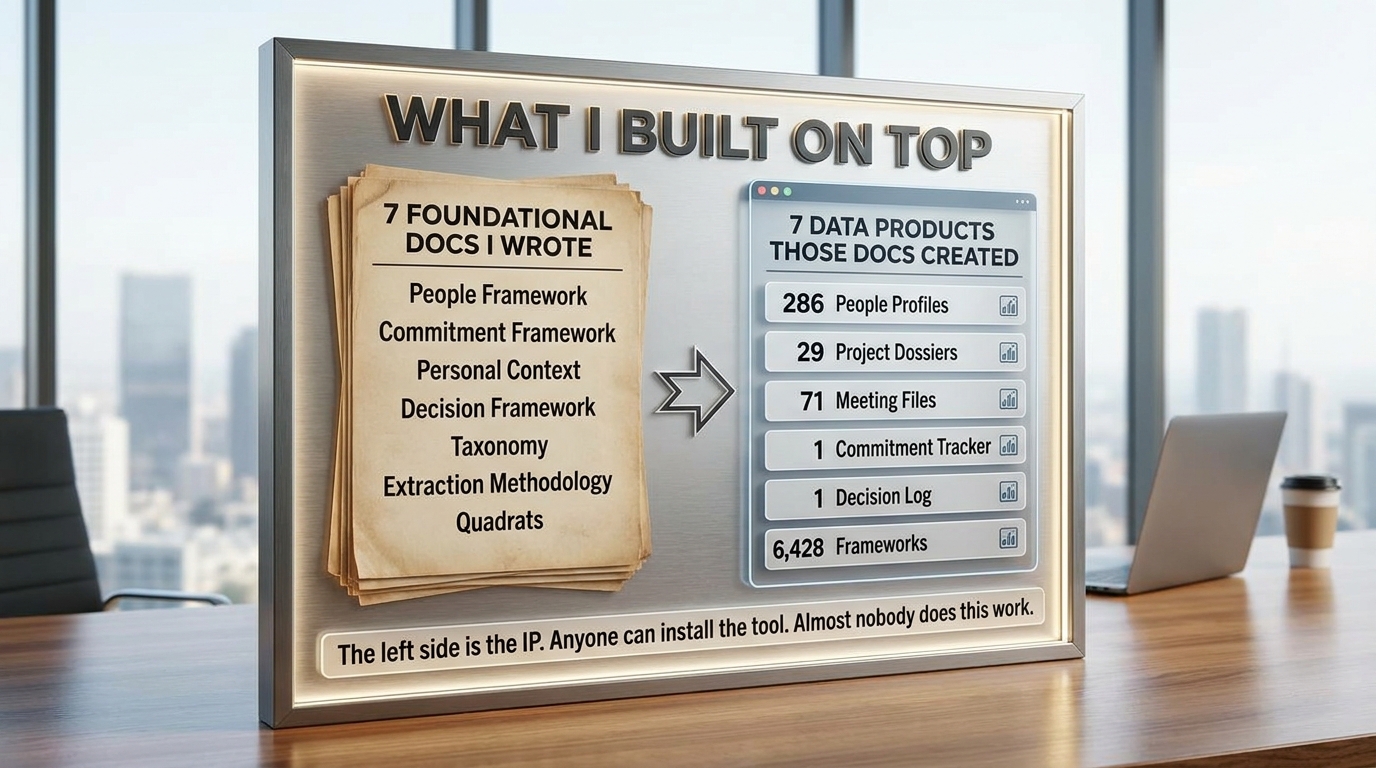
I've built my own personal AI, which I call "Gary" (OpenClaw). It's an open-source AI agent with 145K+ GitHub stars. It runs 24/7 locally on my machine, ensuring my data never leaves my computer. I implemented it by exporting all my Chat GPT conversations, Claude data, emails, and texts, and feeding them into OpenClaw. OpenClaw uses seven foundational files to give it life:
- Soul.md: Its personality, principles, and boundaries.
- User.md: Information it needs to know about me.
- Agents.md: Operating manual for the AI team (sub-agents).
- Memory.md: Long-term memory that persists forever.
- Tools.md: What tools and APIs it can access (email, calendar, browser, web search, code).
- Heartbeat.md: What to proactively monitor (cron jobs).
- Identity.md: Its name, role, and character.
These files turn a generic AI into *my* AI. I taught the AI how to think like me, then I fed it my entire professional life. My structured outputs include 286 people profiles, 29 project dossiers, 71 meeting files, a commitment tracker, a decision log, and 6,428 frameworks from AI conversations. This allows me to ask it, "Hey, what do I have outstanding for so-and-so?" or "What did I say I was going to do?" and it reminds me, or even preemptively gives me a spreadsheet based on my commitments.

My system uses a QMD (Quick Markdown) Hybrid Approach, which is a better search system than the standard RAG-only approach. RAG-only can lose exact names and dates, is slow, has a black box problem (can't see why it returned what it returned), chunks lose context, and is expensive. My QMD Hybrid Approach offers instant keyword search, exact name and date matching, transparent results, full document preservation, semantic fallbacks, local operation (no API calls, no cloud, no cost), and is precise when you know what you want and smart when you don't. It's the engine that never sleeps, running a 24/7 pipeline of Google Drive backups, contact ingestion, meeting transcript extraction, and daily prep dossiers.
Monetizing AI: Fractional AI Officers and Custom Tools
The cost of building custom code is so low that you can build customized tools that save people 80% of their time. This isn't just for massive corporations; it applies to small businesses too. My advice for making money with AI is to learn, just go play. You will figure something out. Secondly, there's huge demand within corporations to just be in the know. If you get educated and cold call, you could literally set up a cloud bot to find all publicly traded companies, cold email their executives, and say, "Hi, I'm Nick. I've been deep in AI for the last year and a half. I know what's coming, and 95% of your competitors don't. I'd love to have five minutes with you to update you on what's coming." You'll probably get rejected by most, but you can perfect that sales pitch. If you can get on their calendar and have a conversation like I did with those executives, within a couple of minutes, they're going to be like, "Oh, I get it. Holy crap, the train is coming. I'm about to get hit."
I think an executive bootcamp, weekly roundtables, or a fractional AI officer is 100% in demand. You don't even have to be an expert in vibe coding; just say, "Hey, I'm going to keep you up to date." They want to know. They don't know how to use it. They're kept from the truth because they know not where to find it. Just putting yourself in a position where you can relay yourself as a subject matter expert (like 2010 social media where people asked, "Oh, you have a Facebook account? Will you run social for us?") that's what it's like in AI right now. "Oh, you use Claude? Can you run AI for us?" Once a week, you could come in and get paid for consulting services. You will make millions of dollars. I've seen it now. Because right now, the traditional way within companies is like, what are they doing? They're writing something down, trying to remember it, or maybe using Copilot, which sucks. There is no way for them to capture what was done in that meeting, save it to some type of archival system they can query later, and then follow up with individuals. That's always been the hardest part: follow up and follow through.
The Power of Learning and Leveraging Foundational AI Principles
If you just record meetings, transcribe them, put them in a place where you're going to check in, and then build some type of accountability mechanism for you to say, "Hey, this was a due-out that you committed to," you're ahead of 95% of people. People get so tripped up on, "I'm going to build this agent," or "I'm going to build this skill." No. Literally, record a meeting, summarize it in a transcript, put it somewhere you're going to check in, and then all of a sudden you've got this superpower because you've got this massive database that you can go back to.
How can people make money learning how to do this and then doing it for individuals or for companies? That is a viable opportunity right now. Right now, there is leverage if you know something. So in my mind, it's like, what is your secret sauce? And now with a cloud bot, I can unlock it because I could hire like two or three people to be my minions. Go all in on it. Go learn. Just go play. You will figure something out, and it will be incredibly valuable.
Want more practical business ideas for the US market?
👉 Follow us on Facebook for daily ideas and tips.
👉 Save ideas on Pinterest — or get them by email.
Note: Comments are being moderated and may take a while to appear. There is no need to resubmit your comment.